A guide for venues
How to host a wedding venue open day — the 2026 guide
This guide is written for whoever runs the venue: the person with a diary full of off-peak Sundays and no plan for an open day. It covers the date, what the day actually costs, an hour-by-hour run sheet, the sign-up mechanics, the twelve questions couples will ask you, and the eight numbers that say whether it worked.
Updated:
What is a wedding venue open day?
A wedding venue open day is a scheduled, free event where a venue invites engaged couples to see the room dressed for a wedding, taste the menu and meet suppliers.
The vocabulary splits along the Atlantic and it is worth getting right, because it is what couples type. In the UK, Ireland and Australia the event is an open day, an open evening or a twilight viewing. In the US and Canada the same afternoon is an open house. A wedding fair — or fayre, and the trade argues about that spelling every January — is a larger event where suppliers exhibit at stands. A showcase sits between the two: the venue dressed as if for a real wedding, with a handful of suppliers styling it.
An open day differs from a show round in three ways. The room is dressed, so a couple sees candlelight, a laid top table and Chiavari chairs instead of a bare floor on a Wednesday morning. Several couples come at once, so the venue looks in demand rather than available. And there is a programme — a tasting, a demonstration, time with suppliers — so a couple leaves with an impression rather than a brochure. It is a wedding with the wedding party missing.
Why should a wedding venue run an open day?
An open day gives a wedding venue one afternoon in which dozens of couples see the room dressed and leave their details, instead of twenty separate show rounds.
Count it in coordinator hours. A show round costs a full hour, plus the call before and the call after; twenty of them is a fortnight of diary broken into pieces nothing else fits between. An open day compresses the same traffic into one afternoon, with one front-of-house team, one stylist and one catering run. The cost per couple falls and the conversation does not, because it happens in the room, at a laid table.
The second gain is commercial. A couple standing in your barn alongside ten other couples can see demand. It is the one afternoon of the year when a venue demonstrates that its Saturdays are contested, and the one on which the question that decides everything — is the last Saturday in June still free? — gets asked out loud, in front of witnesses, rather than in an email you answer on Tuesday.
The third gain outlives the day. A well-run open day leaves a list of engaged couples with an email, a phone number and a wedding date, a set of photographs of a full room that cannot be staged, and a page that stays online working for enquiries for months. A badly run one leaves a pile of business cards and the feeling that a lot of people came.
Open day, wedding fair or private viewing — which should you run?
The venue organises and pays for an open day, exhibitors pay at a wedding fair, and a private viewing serves one couple — three costs, three depths of conversation.
| Format | Who organises and pays | Who turns up | What this format is best at | When in the year |
|---|---|---|---|---|
| Wedding venue open day | The venue; catering and dressing the room are its cost | Couples already considering this venue | A couple stands in your room and sees it dressed for a wedding | January to March, a Sunday |
| Open evening or twilight viewing | The venue; a shorter, cheaper version of the same day | Couples who work, and their parents, after five | Candlelight and low winter sun — the room at its most flattering | November to February, a weekday |
| Venue showcase | The venue, with suppliers styling it in exchange for the exposure | Couples who have shortlisted two or three venues | The strongest visual proof a venue can produce, at supplier-shared cost | February to April |
| Wedding fair or fayre | An outside organiser; the venue pays a stand fee | Hundreds of couples at an early planning stage | The largest number of contacts in one weekend, at the lowest cost per couple | January to February, one weekend |
| Private viewing or show round | The venue; it costs only the coordinator's time | One couple, usually with a date already in mind | The highest conversion in the whole funnel — no crowd, no clock | All year |
When is the best time to hold a wedding venue open day?
Hold a wedding venue open day between January and March, in engagement season, when couples are choosing venues and your own Saturdays are not yet taken by weddings.
Engagement season runs from late November to mid-February — Christmas Eve, New Year's Eve and Valentine's Day carry most of the proposals between them, and the venue search starts within a fortnight of the ring. That gives a clean window: a venue opening its doors in January or February meets couples at the moment they are deciding, in months when its function diary is empty, its stylist is free and its kitchen is not turning a room round from Saturday.
Check the show calendar before you pick a date. A regional wedding fair or a national event such as The National Wedding Show on the same weekend takes both the couples and the suppliers you wanted, and it advertises with a budget you cannot match. Ring your preferred suppliers first — they know the fair calendar better than you do, because they are paying for stands at it.
Then choose the shape of the day. Sunday afternoon suits couples travelling from two different towns, often with parents contributing to the wedding. A weekday open evening from five until eight suits couples who work, and winter light at four o'clock does more for a room than any photograph. If your team can carry it, run the event across two or three days and market it as open days — you double the chance one of them fits a couple's weekend.
How much does it cost to run a wedding venue open day?
Nobody publishes a benchmark for what a wedding venue open day costs, and only three lines move the budget: catering per head, dressing the room and paid reach.
3 lines
Catering per head, dressing the room and paid reach are the only costs that scale. Everything else on the day you already own.
0
What a Facebook event, an Instagram story and an email to your own enquiry list cost. Reach you already own is free.
1 booking
One extra wedding out of one open day covers the whole day several times over, at any per-head price a venue charges.
We looked for a published cost benchmark for a wedding venue open day and found none in any market, so no range is printed here rather than an invented one. Catering, styling and staffing are the three lines that move, and all three are priced locally — a figure from another country would read as authority and mean nothing. If your own open day has real numbers behind it, they are worth more than any benchmark on the internet, and they are the ones to budget from next year.
We looked for a published cost benchmark for a wedding venue open day and found none in any market, so no range is printed here rather than an invented one. Catering, styling and staffing are the three lines that move, and all three are priced locally — a figure from another country would read as authority and mean nothing. If your own open day has real numbers behind it, they are worth more than any benchmark on the internet, and they are the ones to budget from next year.
How many couples come to a wedding venue open day?
No published research counts attendance at wedding venue open days, so any average quoted online is a guess; the only reliable figures are the ones your own day produces.
The benchmarks that circulate belong to a different event. EverBridal's widely repeated figures — average venues converting 30–40% of tours into bookings, top performers 60% or more, in-person visits converting at 40–60%, show rates of 70–85% — are their figures, and they describe a private tour by a couple who has already shortlisted you. An open day is a group visit at a far earlier stage of intent, so multiplying attendance by a tour conversion rate is how a venue talks itself into a number Monday disproves.
What you can control is turnout, and there are only three levers: a capacity you publish, a sign-up list you can close a week out, and a reason to arrive at a particular hour. A ticketed open day — even at a token price — raises the show rate sharply, because a couple who has paid turns up; it costs you some of the reach a free event gets, so it is a trade between the size of the crowd and the certainty of the list.
Then measure the thing you actually sell. Sign-ups, guests who arrived, and couples who asked about a specific date are three numbers that mean something year on year, in your own market, at your own price point. One venue's honest year-on-year comparison is worth more than every industry average on this page, and it is the only benchmark nobody can dispute with you.
The wedding venue open day timeline: eight weeks
Eight weeks is enough: −8 is the date and the suppliers, −4 the page and invitations, −1 confirmations and printing, the day itself, +48 hours the replies.
Minus eight weeks: date and suppliers
Pick an off-peak Sunday and check it against the regional fair calendar. The same day, invite suppliers — one firm per category, with an arrival time, an amount of floor space and a deadline to reply. A supplier who has not answered in a week will not turn up in eight. Set the capacity and the catering budget now, because everything below depends on both.
Minus four weeks: page and invitations
Build the event page first: the hour-by-hour programme, supplier profiles, the tasting menu, photographs of the room dressed, and the sign-up form. Only then create the Facebook event and put the link in it, so the invitation leads somewhere that collects details. This is also the week you email every couple who enquired in the last year and did not book.
Minus one week: confirmations and printing
Close the list, send a confirmation with the time and address, and order catering against the number on the list plus a margin — not against a feeling. Print the QR sheet: one code for the event page, one for the guest zone, one per supplier stand and one per passport stop. Cut, mount and place them on the Saturday evening, not the Sunday morning.
On the day: four roles
One person owns the door and the register, one leads the tours, one answers the phone, one talks about available dates. Every supplier has their own QR code on their stand. A couple asking about June 2028 leaves that date in writing, on the form, not in the coordinator's memory. Take photographs of a full room while it is full — you will use them all year.
Plus 48 hours: the replies
Open the leads screen and work down it in sign-up order, starting with the couples who asked about a specific date. Every reply should carry that couple's wedding date in the first line, because it is the one sentence that proves the email was not sent to everybody. In the same window, send each supplier photographs from their stand and a thank-you, so they come back next year.
12 things to do before your wedding venue open day
Twelve tasks in four groups — the venue, the suppliers, promotion and the logistics of the day — in exactly the order the eight-week timeline puts them in.
- Date, hours and capacity
- An off-peak Sunday, an afternoon, and a number of couples you can actually host.
- The regional fair calendar for that weekend
- Check every fair within an hour's drive before you print anything.
- Supplier invitations
- One firm per category, in writing, with floor space and a reply deadline.
- An hour-by-hour programme
- Four blocks, each with an owner and one thing a couple takes away.
- The event page with a sign-up form
- Programme, suppliers, menu, photographs and registration at one address.
- A date-checker section
- The couple picks their wedding date; you get it as a sortable field.
- The tasting menu and dietary marks
- Vegetarian, vegan and gluten-free labelled before anyone asks at the table.
- A package or a from price good on the day
- One reason to decide on Sunday rather than think about it.
- One table dressed in full
- Linen, glassware, favours, centrepiece — one table finished, the room ready.
- The printable QR sheet
- Event page, guest zone, supplier stands and passport stops on one sheet.
- A Facebook event linking to the page
- The invitation in one place, the sign-ups in another, always that way round.
- Roles for Sunday
- Door, tours, phone, dates — four people, four jobs, one briefing.
The order is the same as the eight-week timeline above — work down it, not through whichever task is the most enjoyable.
A wedding venue open day run sheet, 2pm to 8pm
Six hours in four blocks: arrival and tours, the tasting, one demonstration, then the date conversations — each block with an owner and one thing to take away.
1pm — the hour before doors
Table dressed in full, candles lit, music on. Suppliers load in by one o'clock, because at a quarter to two somebody is always looking for an extension lead. The QR codes on the stands are already mounted and have been scanned once by a phone that has never seen them before. Last job: walk the tour route in the order the couples will walk it.
2pm — doors and the register
One person on the door and one list of registered couples. Anyone who has not signed up signs up there: names, email, phone, wedding date, and a tick to say the venue may contact them. That is the whole difference between an open day and a free party — five fields at the door. Beside them, the guest-zone QR code and a card with the access code.
2.30pm — tours in small groups
Groups of six to eight couples, leaving every twenty minutes, on one route: ceremony room, reception room, the bar, the garden or the marquee site, then the accommodation. Show the things photographs cannot: where the band sets up, how staff get in and out, where the power is under the top table. Every group finishes at the fully dressed table.
4pm — the tasting
Four or five plates, one from each course, served the way they are served at a wedding rather than handed round on a tray. This is the only hour of the day when a couple learns what your per-head price actually buys, and the only one in which you can talk about that price without awkwardness. Put printed descriptions and dietary marks beside them.
5pm — one demonstration
A bridalwear show is the classic, and the boutique runs it for nothing because it leaves with a season's content. Twenty minutes, music, a walk through the room, done. A first-dance demonstration with a dance school or a cocktail-making showcase works as well. One spectacle, not three — three means nobody is talking to you about a date.
6pm — the date conversations
This is the block the whole day exists for. One person, one table, the diary on screen and the date-checker form open on a tablet. A couple gives their date, you say whether it is free, and the enquiry is written down as a date rather than remembered as a conversation. Anything provisionally held gets a follow-up time agreed out loud.
7pm — grazing table and sweets
The last hour is deliberately loose and that is its job. The couples who are still deciding are the ones who stay, and they talk for longer over food than they ever do during a presentation. This is also when a live gallery earns its place: guests upload photographs from their phones and the page fills with material you could not have produced.
8pm — close and annotate
Before the linen comes off, go through the register and add what could not be captured at the door: who asked about June, who came with parents, who you promised to ring on Monday. Fifteen minutes at eight on a Sunday is worth more than an hour on Tuesday, when nobody remembers which couple was which.
Which suppliers should you invite to a wedding venue open day?
Invite one firm per category: suppliers bring their own couples and promote the day to their own audience, but two photographers side by side watch each other instead of working.
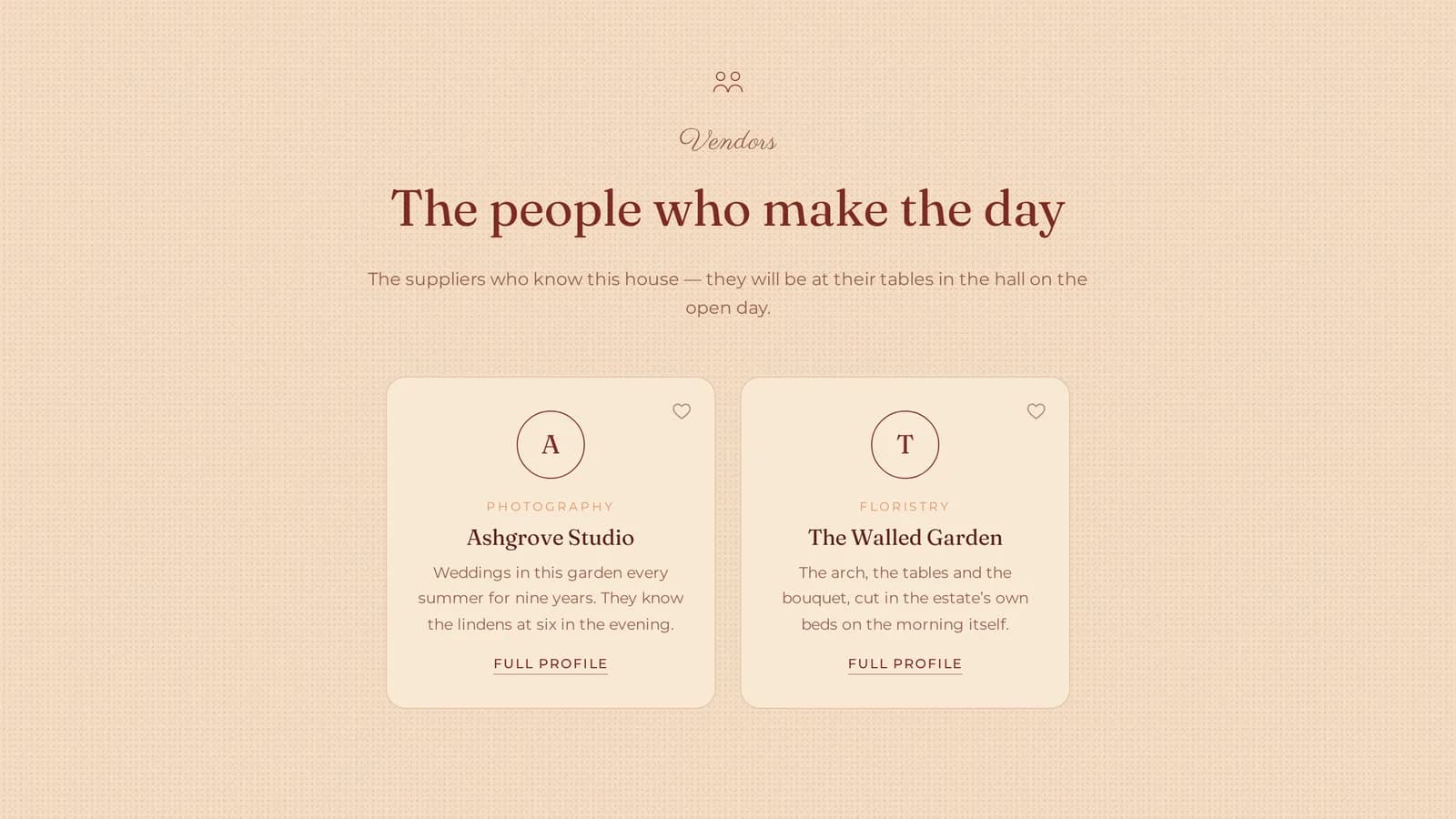
The categories barely change: photographer, videographer, band, DJ, florist or stylist, cake maker, photo booth, bar, children's entertainer, bridalwear boutique, stationery, hair and make-up, dance school, transport. Pick eight to ten, one firm per category, and say so in the invitation — a supplier who knows they are the only photographer in the room brings a better portfolio and invites their own couples. On an open day they are suppliers; save exhibitor and stand fee for a wedding fair.
Write the trade down, because it is a trade. They get floor space, power, their logo on the event page and a profile with a portfolio; you get their audience and a stand that costs you nothing. It is least work when each supplier fills in their own card — an email invitation, their description, their logo and up to eight portfolio photographs — instead of thirty attachments in your inbox. One rule governs the list: if you are showcasing them, you are endorsing them.
Should you publish the open day programme before the day?
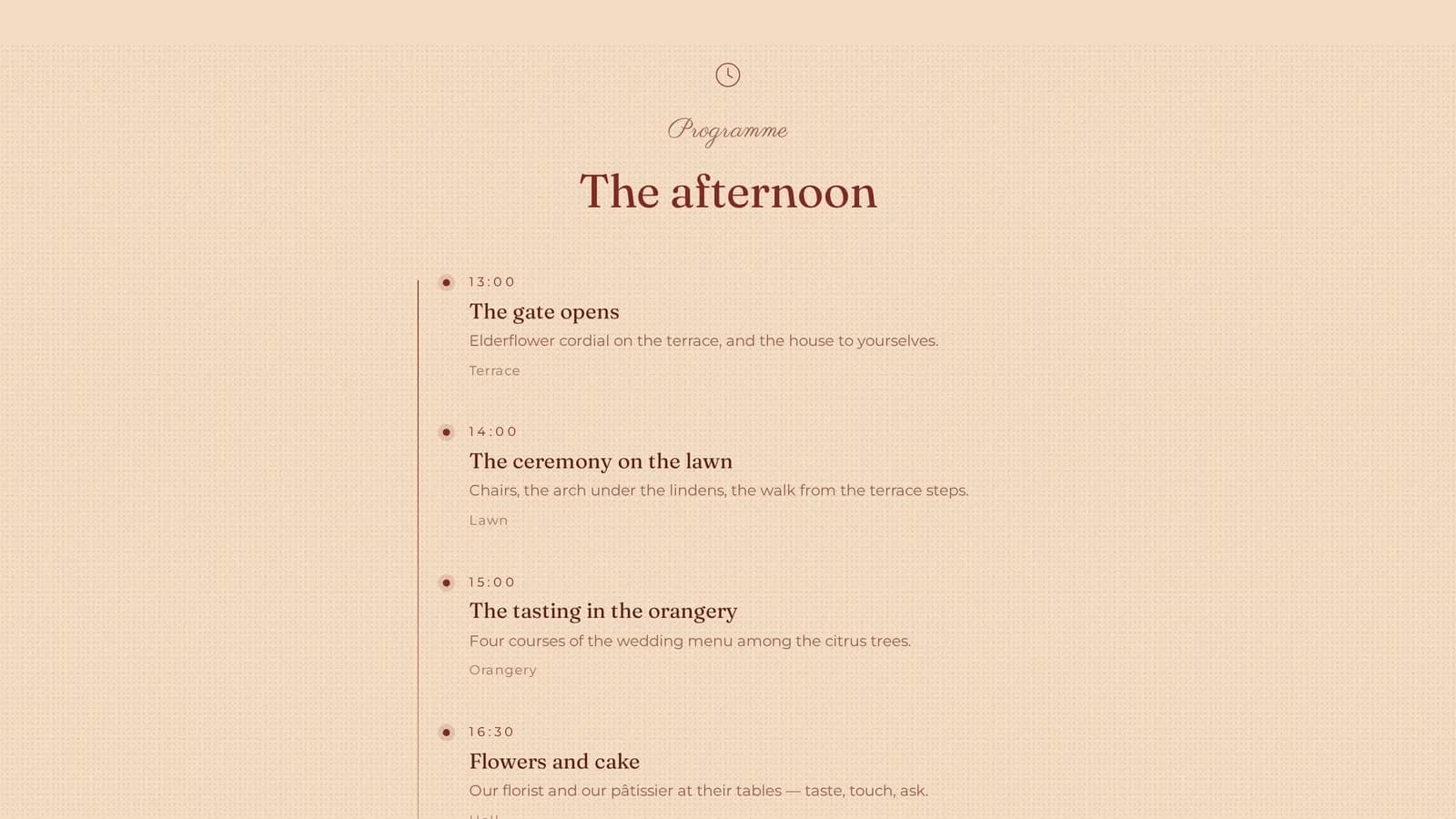
Yes — a published hour-by-hour programme is the most read part of an open day page and it decides what time a couple arrives and how long they stay.
A couple who reads only “doors from 2pm” arrives at ten past, walks the room and leaves at twenty-five to three. A couple who can see that the tasting is at four and the bridalwear show at five plans for two hours and stays for both. The programme is an attendance tool, not decoration: every entry needs a time, a title, one sentence of description and a location, because each one gives somebody a reason not to leave before the block where dates get discussed.
The same programme then works a second time on the day itself. If it is on the page with real times, a bar appears at the top showing what is on now and what is next — the one thing on an event page that is on by default rather than switched on. Guests stop asking staff what is happening, and the venue types the running order exactly once.
How do you promote a wedding venue open day?
A Facebook event does the inviting, directories reach couples already searching, suppliers share the day with their own audience, and your own enquiry list is cheapest.
The Facebook event
Still the best invitation mechanic there is: no cost, native sharing, and a first reply in Messenger faster than any form manages. Two limits are worth naming. The Interested list is Facebook profiles, not emails, phone numbers and wedding dates. And the reach is rented — archive the event and a post remains. Leave the invitation where it works; let the button lead to a page that collects details.
Listings in wedding directories
Directories reach couples at a moment you cannot buy: they are already searching for a venue in a county, on a date, at a budget. The listing is worth having not because anyone reads the description but because it catches a couple mid-decision. Add the open day date to it and link to the event page — the directory is distribution, the page is where a couple signs up.
Your suppliers as a channel
The most underrated line here and the only free one with real reach. Eight firms, each with a few thousand engaged followers, will share the day because they are standing in it. Ask for it in the invitation, supply the artwork and the link, and agree a publication date — otherwise everyone posts on Saturday evening and the reach lands after the doors close.
Your own enquiry list
The cheapest and warmest audience a venue has, and the one it forgets: every couple who enquired in the last twelve months and did not book. A good share of them still have no venue. One email four weeks out, with the date, the programme and a link to sign up, produces turnout no advertising can buy, because these people already told you they liked the place.
QR codes at partner businesses
A QR code on the counter at the florist, the bridalwear boutique, the cake maker and inside your own restaurant costs the price of printing. It reaches people who are already planning a wedding and takes them straight to the sign-up form. Make sure the code opens the page in the language you wrote it in — nothing undoes the impression faster than an English page opening in something else.
Instagram, as process rather than announcement
Instagram will not sell an open day with a poster, but it will sell it as a process: the table being laid, the kitchen trialling the menu, the florist carrying stems in on Saturday. Three stories in the week before beat one polished graphic, because they show the room moving. The full year-round plan sits in our wedding venue marketing guide.
How do you collect sign-ups for a wedding venue open day?
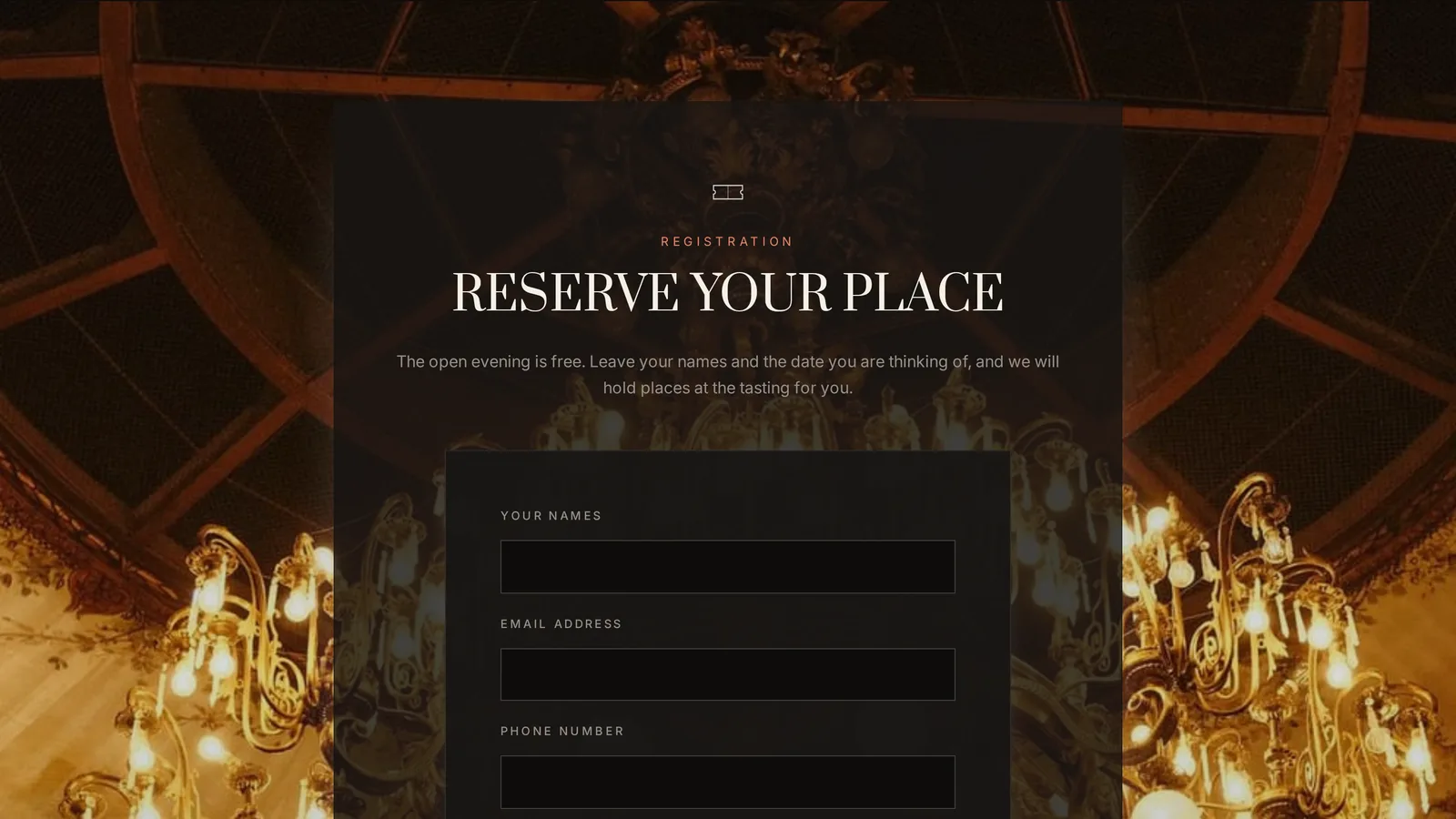
Most venues still take open day sign-ups by email, by phone or through a ticketing tool; a form on your own page adds the phone number and the wedding date.
Look at how it is actually done and the problem states itself. One banqueting complex takes registrations by email and asks couples to keep the thread going with the wedding date in the subject line — so the CRM is an inbox and the segmentation key is a subject header. A hotel sells tickets to its own open day through an external site, so the couple's details reach the ticketing platform before they reach the hotel. The third pattern is phone registration with a cut-off date.
A form on your own page adds three things. It asks for the couple's names and an email, asks for the wedding date by default, and can ask for a phone number and a guest count. It requires an explicit tick consenting to contact from the venue, so consent is a stored field rather than an assumption. And it lands as one table: couple, email, phone, wedding date, guests, time received. Beside it sits a date checker, and those enquiries land separately with the date as its own column.
12 questions couples will ask you at a wedding venue open day
Twelve questions come up at every open day; answer them once on the page, in the offer, the menu and the FAQ, and the afternoon is free for the rest.
- “Is our date still available?”
- The date-checker section: the couple picks a date, you get a sortable field.
- “What is the minimum spend?”
- The offer section, by day of week and by season, stated plainly.
- “What is included in the hire fee?”
- The offer section: what is in the package, and what sits outside it.
- “Is it exclusive use?”
- FAQ, one sentence: one wedding a day, or two rooms running.
- “Are you licensed for civil ceremonies?”
- FAQ: approved premises status and which rooms are licensed.
- “Can we bring our own suppliers?”
- FAQ: preferred supplier list, and what happens off it.
- “What is your corkage?”
- FAQ; leaving this out generates the most calls after the day.
- “What time does the bar close and the music stop?”
- FAQ: curfew, extension cost and any noise limiter.
- “What deposit do you take and when?”
- FAQ: amount, payment schedule and what is refundable.
- “How many can you seat and sleep?”
- FAQ or the offer: seated capacity, standing capacity, bedrooms on site.
- “What is the wet-weather plan?”
- FAQ, with a photograph of the indoor ceremony set-up beside it.
- “Can you do vegan, gluten-free and children's menus?”
- The menu section, with dietary marks on the dishes themselves.
These are the questions UK and US couples are coached to ask on a venue visit — answer them on the page and the afternoon is spent on the interesting ones.
What happens at the venue on the open day itself?
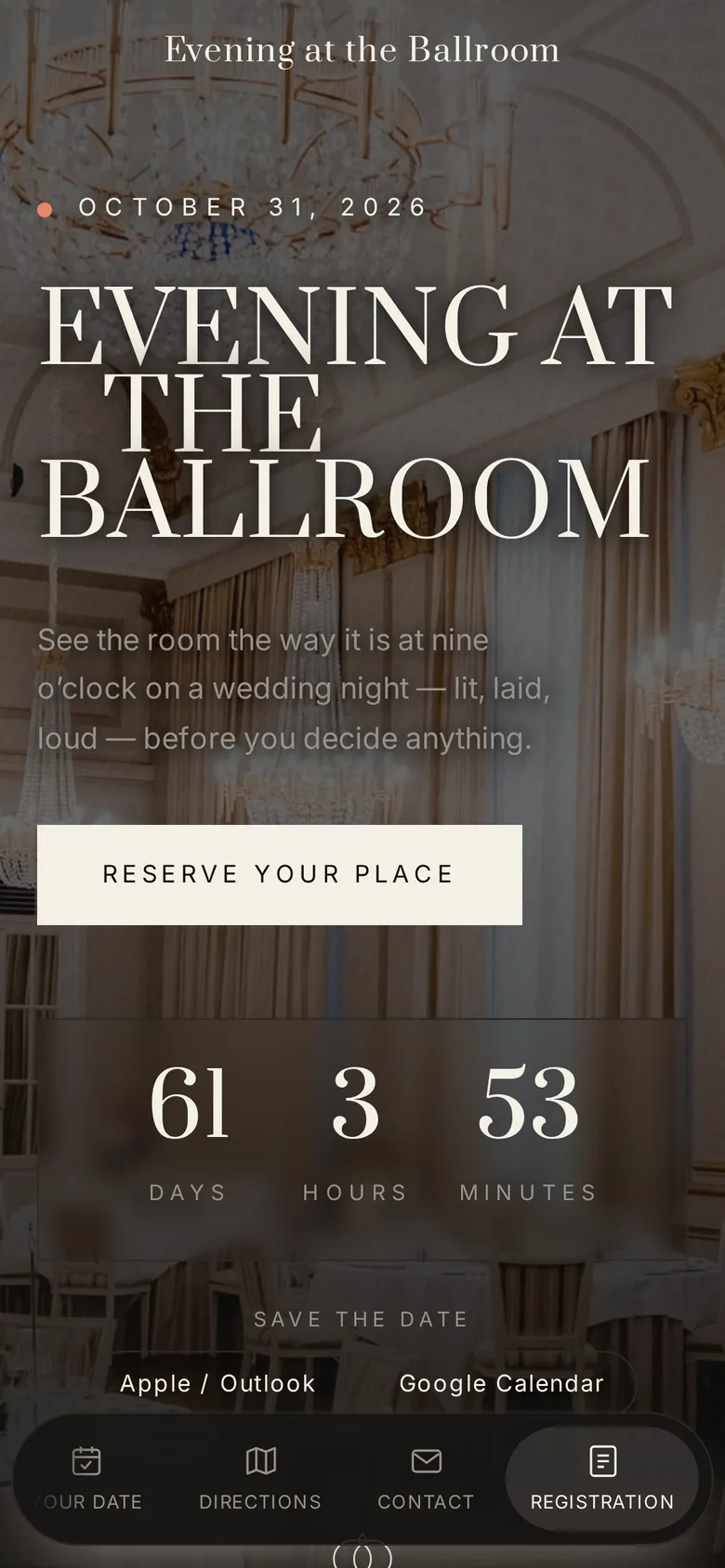
On the day a QR code by the door opens the guest zone, a now-and-next bar appears on the event page, and guests collect passport stops.
The entire physical layer of an open day is one printed sheet carrying four kinds of QR code: one for the event page, one for the guest zone, one per supplier stand and one per passport stop. Nobody installs anything — the code opens in a phone camera. QR codes stopped being a novelty some years ago; the venues that still hesitate are usually thinking of 2015, not of a room where every guest is already holding a phone with the camera app open.
Everything beyond that is a choice, not an automatic feature. You can switch on a guest zone locked behind a four-digit access code, so a price list or the day's photographs are only for the people who came — and change those digits next morning to revoke access from everybody at once. You can switch on an event passport: codes at the experiences around the property, which walk guests through the whole venue rather than letting them cluster at the bar. Only the programme bar is on by default.
What do you do in the 48 hours after an open day?
Reply to every couple with their own wedding date in front of you, in sign-up order, starting with the ones who asked about a specific available date.
The rhythm that works has four points. Sunday evening, within two hours of the doors closing: a short thank-you to everyone who registered, with a link to the page. By Monday lunchtime: individual replies to the couples who asked about a date, each carrying that date in the first sentence. Within 48 hours: a call to those who left a number. After a week: photographs from the day and one question — would you like to see the room privately?
One honest caveat. Nothing is emailed to you. New sign-ups and date enquiries do not trigger a notification; the leads screen has to be opened, and opening it is the first job on Monday morning. Why it matters is well documented — speed of reply is the best-evidenced conversion lever in the whole funnel, and we set out the research with its numbers in our wedding venue marketing guide. Here the rule is enough: a couple who waits three days spends those three days talking to somebody else.
There is also an asset most venues never collect. An open day page does not vanish the way a Facebook event does: it stays online with photographs of a full room, the programme and the supplier profiles, so a couple who hesitated in March has somewhere to come back to in May. And send every supplier photographs of their own stand with a specific thank-you — that exchange is the whole conversation about whether they come again next year.
How do you measure whether a wedding venue open day worked?
With eight numbers: page views, guest-zone entries, QR scans, registrations, date enquiries, questions, saved suppliers and completed passports.
- Page views
- How many saw the invitation — a measure of promotion, not turnout.
- Guest-zone entries
- How many used the access code, which is how many were actually there.
- QR scans
- Whether anyone scanned the codes on stands and at the experiences.
- Registrations
- Couples signed up, with names, email, phone and wedding date.
- Date enquiries
- Couples who named a specific wedding date — the hottest part of the list.
- Questions
- Messages sent through the contact form, counted separately from sign-ups.
- Saved suppliers
- How many couples shortlisted one of the firms you invited.
- Completed passports
- How many guests walked the whole property rather than one room.
Eight numbers on one screen — this is the sheet you put on the table when next year's marketing budget is discussed.
Seven mistakes that ruin a wedding venue open day
The most common mistake is having no sign-up list: nobody knows how many will come, so catering is guessed in both directions and the contacts are lost the same evening.
No sign-up list
Phone registrations leave a number in a call log, email leaves a thread and Messenger leaves a nickname. Three days later nobody can turn those into one list, and a week before nobody can tell the kitchen how many to cook for. Too much food is written off; too little is the first impression a couple takes home.
No follow-up afterwards
The most expensive mistake here, because the money has already been spent. A venue runs the day, collects sixty contacts and gets in touch a week on Tuesday, by which time several couples have signed elsewhere. Follow-up is not a stage after the event; it is the only reason the event happened.
Two firms in one category
Two photographers in one room watch each other instead of working, and neither invites their own couples when they have to share them with a competitor. The rule is simple: one firm per category, stated in the invitation. Then everyone arrives with a full portfolio and their own audience rather than with caution.
A date in peak season
An open day in July is cost without revenue: couples marrying this year have chosen already, the team is tired from Saturday and the stylist has no hands free. The enquiry season is January to March, when the weddings are still ahead of you. The other version of this mistake is a weekend when a large regional fair is on.
No programme, so people drift out
With no times, nobody knows why to stay. A couple walks in, does a lap, says how lovely and leaves after twenty minutes — before anybody has asked about their wedding date. A programme with real times, a tasting at four and a demonstration at five, is the only tool that holds people in the room until the block where dates get discussed.
Nobody counted the day
“A lot of people came” is not a result. Without the number of sign-ups, the number of date enquiries and the number who actually arrived, this year cannot be compared with last year and the budget cannot be defended to an owner. Nor can anything be improved, because nobody knows which part of the day worked.
Suppliers leave without numbers
They stand for six hours, hand out cards and drive home with a feeling. A year later you ask them to come again with nothing to show them. If every supplier leaves with photographs and specific numbers from their own stand, next year's conversation — and any conversation about a stand fee — looks completely different.
Wedding venue open days: frequently asked questions
What is a wedding venue open day?
A wedding venue open day is a scheduled, free event at which a venue opens its doors to several engaged couples at once, with the room dressed as it would be for a wedding. Couples tour the space, meet a handful of suppliers, taste the menu and ask about available dates in one visit. US venues call the same event an open house; a larger event with many exhibiting suppliers is a wedding fair.
Open house or venue showcase — which should you call it?
Call it an open house in the US and an open day in the UK; call it a showcase when suppliers dress the venue as if for a real wedding. The distinction sets expectations: an open house promises access and a look around, a showcase promises a styled room and a shortlist of suppliers. Couples search for both phrases, so name the format you are actually running rather than the one that sounds grander.
How far in advance should you plan a wedding venue open day?
Plan a wedding venue open day about eight weeks out, which is the window the venue-marketing guides that rank for this question recommend, some stretching it to twelve. Suppliers need six to eight weeks to commit and to promote it to their own audiences, and the marketing itself works best in the four to six weeks before the day. Less than four weeks and you are relying entirely on people who already follow you.
How long should a wedding venue open day last?
Four to six hours is the usual length, most often two until eight on a Sunday or five until nine for an open evening. Shorter than four hours and couples travelling any distance cannot fit it in around another viewing; longer than six and your team is running on empty by the block where dates actually get discussed. Publish the finish time — couples plan the rest of their day around it.
Do you need suppliers at a wedding venue open day?
No, and some venues deliberately run open days with no suppliers or very few, keeping the focus on the building itself. Suppliers earn their place when they bring their own audiences and dress the room to a standard you could not afford to hire for the day. If you invite them, invite one firm per category and remember that showcasing a supplier is endorsing them.
Should a wedding venue open day be free to attend?
Free entry is right in most cases, because it removes the only barrier to turning up and lets you invite broadly. A ticket, even a token one, is a legitimate attendance tool: couples who have paid arrive, so you know how many to cater for. It costs some of the reach a free event gets, which makes it a trade between the size of the crowd and the reliability of the list.
How do you get the right couples to show up?
Target reach you already own before you buy any. Email every couple who enquired in the last twelve months and did not book, ask each invited supplier to share the day with their own followers on an agreed date, and put the event in the directories where couples are already searching for a venue in your area. A Facebook event does the inviting; the sign-up form on your own page does the collecting.
How many bookings should a wedding venue open day produce?
Nobody publishes a reliable benchmark, and the figures usually quoted describe private tours rather than open days. EverBridal, for instance, reports that average venues convert 30–40% of tours into bookings and top performers 60% or more — their figures, about a different event. Multiplying open day attendance by a tour conversion rate overstates it badly. Measure sign-ups, date enquiries and bookings traced back to the day, and compare year on year.
How much does it cost to run a wedding venue open day?
There is no published benchmark for a UK or US open day, and we would rather say so than invent a range. Three lines move the budget: catering per head against your expected turnout, dressing the room, and any paid reach you buy on top. Everything else — the room, the team, the suppliers' stands, the invitation — you already own or they provide. One extra booking covers the whole day several times over.
You hosted an open day — now what?
Work the list within 48 hours, in sign-up order, starting with couples who named a specific date. Send individual replies carrying that couple's wedding date in the first line, ring the ones who left a number, and follow a week later with photographs and an offer of a private viewing. Send every supplier images and numbers from their own stand. Nothing is emailed to you automatically, so opening the leads screen is Monday's first job.
Build your open day page
The programme, the suppliers, the menu, the sign-ups and the QR codes at one address a couple opens on a phone.
You click, you give an email, a link arrives, and you are in the studio. No password, no card, no sales call.