A guide for organisers
How to run a wedding fair at your venue
This guide is for a wedding venue running its own fair or fayre rather than buying a stand at somebody else’s: how to pick a weekend, recruit exhibitors, price a stand, build the floor plan, and what to send exhibitors afterwards so that they book again.
Updated:
What is a wedding fair at a venue?
A wedding fair at a venue is an afternoon when a venue opens its rooms to exhibiting suppliers, so engaged couples meet a whole local trade in one visit.
Four English words describe four different events, and fizzydo.co.uk draws the cleanest line between them. An open day is “often a straightforward ‘open door’ event that venues arrange”, with “no suppliers at Open Days (or very few)”. A showcase is hosted “in collaboration with local suppliers who dress the venue as if for a wedding”. A wedding show is the arena version, “in excess of 60 suppliers”. A fair sits between the showcase and the show, and it is the one that sells stand space.
The spelling argument is real, and you can settle it in a line. UK venues advertise both “wedding fair” and “wedding fayre”; Collins calls fayre a pseudo-archaic spelling of fare, and diverse-events.com runs a page titled “It’s ‘FAIR’ not ‘FAYRE’”. Pick one for the event name, keep the other as a synonym on the same page, and never build a second website for it. American readers call the same event a bridal show or a wedding expo, and a stand a booth.
Wedding fair or open day — which should you run?
The difference is who pays: an open day is funded by the venue and produces a list of couples, while a fair is funded by exhibitors and produces stand fees.
An open day is your money. You pay for the canapés, the dressing and the staff, and in return the attention is undivided: couples walk your rooms, look at your table settings and talk to you about their own date. You leave with a list of engaged couples and their wedding dates, which is what makes a February follow-up possible. The open day guide covers that day hour by hour.
A fair is your exhibitors’ money. Instead of a catering invoice you have stand fees, and every exhibitor brings their own following through the door. The price is that you stop being the main attraction. With thirty stands, a couple spends a few minutes with you and the rest of the afternoon with a photographer and a cake maker. A venue running a fair needs its own stand, its own sign-up form and its own slot in the programme.
Most venues start in between: an open day with a handful of suppliers, a dress show and a tasting. It has some of the reach of a fair and the intimacy of an open day, and you stay the host. A full fair — stands, terms and conditions, a floor plan — is easier once you have numbers from a previous event, because numbers are what stand space is sold with.
How do you attract exhibitors to a wedding fair?
An exhibitor buys access to couples, not square metres, so a fair is sold with last year’s numbers, a floor plan and a date no bigger show has taken.
Start with your supplier list
The photographer, videographer and cake maker already on your recommended list will come first and bring others with them. An invitation from a venue that sends them weddings outweighs an email from an organiser they have never met. Close the first ten by phone, then use their names to sell the rest of the room.
One category, one exhibitor
Three photographers in one room means three unhappy exhibitors and a couple who remembers none of them. Category exclusivity is the strongest pricing argument you have and the only one that costs you nothing. Write the category list before you sell anything: photographer, videographer, band, DJ, florist, cake, photo booth, bridal wear, stationery, hair and make-up.
Send terms, not an invitation
Exhibitors decide from a document, not a chat. Terms and conditions, the stand price list, load-in and load-out times, the application deadline and exactly what the fee includes. Without that you get “let us think about it”. With it you get a bank transfer, and you know how many stands are still unsold.
Show the floor plan immediately
An exhibitor buys a position, not a size: by the door, by the stage, next to the coffee. Anyone who can see the plan chooses faster and pays faster, and you stop negotiating the same corner with four people at once. The numbers on the plan must match the numbers on the cards at the stands.
Ask for a full profile
You can invite each exhibitor by email to fill in their own card: description, category, links, logo and up to eight portfolio photographs. They edit only their own card and can reach nothing else in your account. That is thirty supplier profiles you do not have to write yourself.
Trade reach instead of ad spend
A local wedding directory, the regional press and the exhibitors’ own audiences will do more than the advertising budget you do not have. Put it in the terms: exhibitors share the event from their own pages. It costs them nothing, and it is the only reach at a venue fair that is genuinely free.
What size should a stand be, and what does it include?
A wedding fair stand at a venue is usually a table-sized pitch: space only means bare floor, while a shell scheme stand adds walls, lighting, carpet and a power socket.
Real venue fairs sell small pitches. The Guildhall Wedding Fair in Salisbury defines its stand as “1 x 6ft table, 2 chairs and table cloth”. The Big Southwest Wedding Fair sells a 6ft × 4ft space and prices it by floor — downstairs costs more than upstairs, which is the argument for a floor plan in a single line. Anything larger, such as bridal wear rails or a wedding car, needs its own size and its own price.
Two phrases separate the options. Space only is the bare pitch: no walls, no lighting, no carpet, and the exhibitor dresses it themselves. A shell scheme stand adds panelling, carpet, a bin, a power socket and lighting. A wedding venue does not own a shell scheme system, so do not promise one: sell space plus a specified table, cloth, chairs and socket, and say which walls, if any, may be used.
At this size, position matters more than area. A stand open on one side is the standard; a corner stand is open on two, an island on all four. Corners and islands sell first, so they should be the most expensive squares on your plan, and they should go to the categories that draw a queue — photo booth, cake, bridal wear.
How do you build a floor plan for a wedding fair?
A wedding fair floor plan is built from the venue’s own drawing: upload it, drag stands onto it, and a visitor taps a stand to open that exhibitor’s card.
Start from a drawing you already have — the wedding table plan of the room, or a sketch of where the stands will go. Upload it as the plan background, add a stand, give it a label, set its width and height, and drop it where the trestle will actually stand. Each stand is then linked to one exhibitor from your line-up, so the plan and the exhibitor list cannot drift apart.
What a visitor gets is the part no photograph of a plan can do: they tap a stand on the phone and the exhibitor’s card opens — category, description, links, photographs. A picture of a plan is not clickable, and a PDF on a phone is pinch-zooming to find a number nobody memorised. The plan is a section of the page, not an attachment to an email.
What the plan does not do: it does not sell stands and it does not reserve them for you. Allocation stays your decision, and the plan only shows it. Publish it before the last stands are sold and it works twice — once for the exhibitor choosing a position, once for the couple on the day looking for the photo booth.
How does a QR event passport work at a fair?
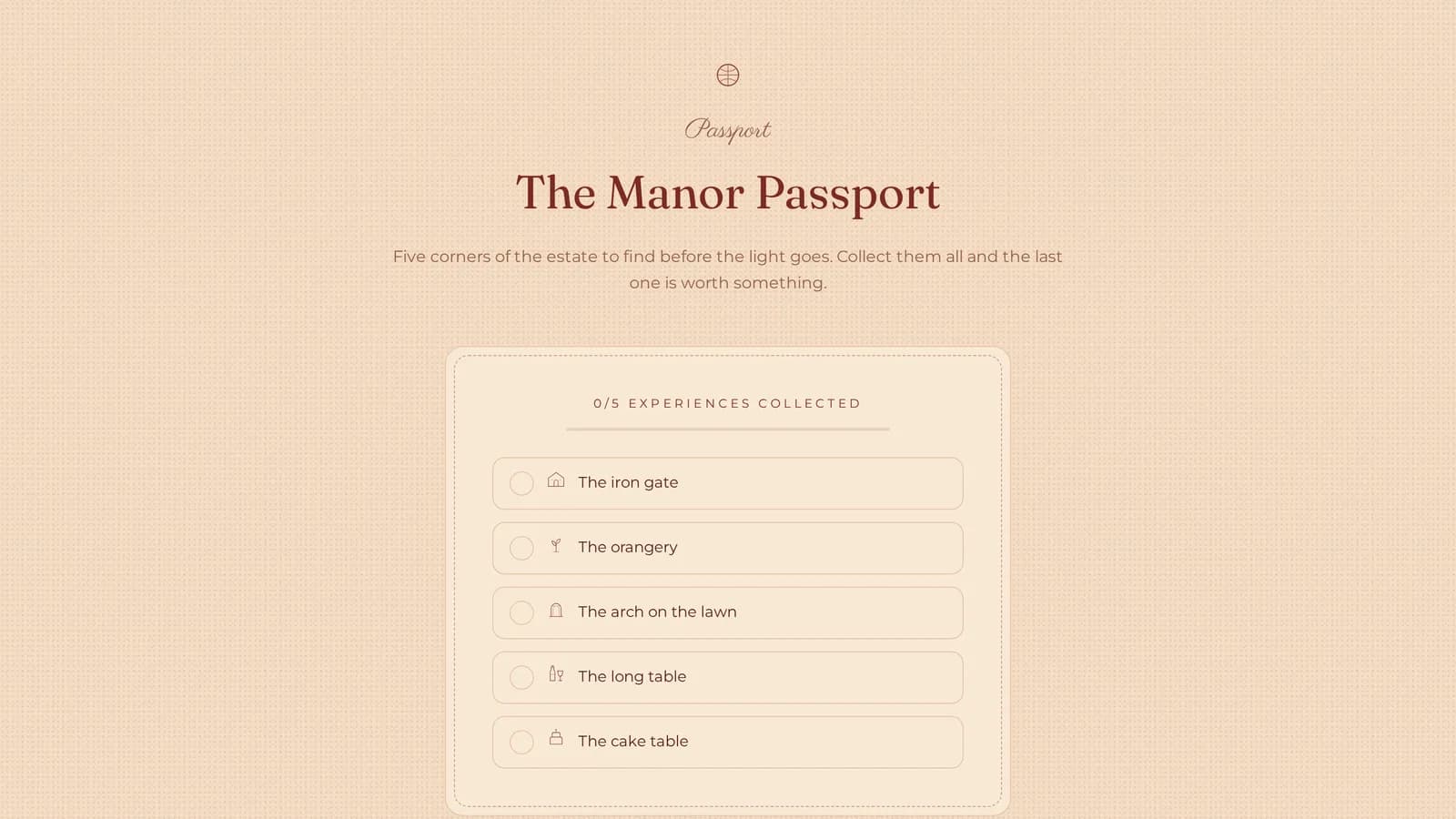
An event passport is printed QR codes around the venue: a visitor scans them as they go, and a full set reveals the venue’s reward code.
The passport is a section you add to the page and a set of codes you print and hang. Each code is one stop: a stand, the cake tasting, the photo booth corner, the terrace. Visitors scan with the phone camera — no app, no account — and progress is stored in their own browser rather than in your database, so nobody has to sign up to take part.
Completing every stop reveals a reward code you write yourself: a discount on a booking, a bottle on signing, a free tasting. Mostly, though, it is a crowd-routing tool. If the three stands by the stage have a queue while four by the windows are idle, put the stops by the windows. The exhibitors at the far end of the room will be the first to notice the difference.
Which QR codes do you print for a wedding fair?
One printable sheet produces four kinds of code: the event page, the guest zone, one code per exhibitor stand, and one code at every passport stop.
- Event page
- For posters, invitations and flyers — opens the fair page.
- Guest zone
- Unlocks the restricted sections on scanning, with no code typed.
- Exhibitor stand
- One code per exhibitor; their scans are counted separately.
- Passport stop
- One code at each experience a visitor is meant to collect.
- One printable sheet
- Every code on one page: print it, cut it, place it.
- SVG download
- Each code on its own, for an exhibitor’s own pull-up banner.
- Page language
- The code opens the page in the language it was written in.
- No app needed
- Guests scan with the phone camera; there is nothing to install.
The QR sheet is generated from the page you have already built, and it is reachable by the account owner and admins only.
How do you run the live programme on the day?
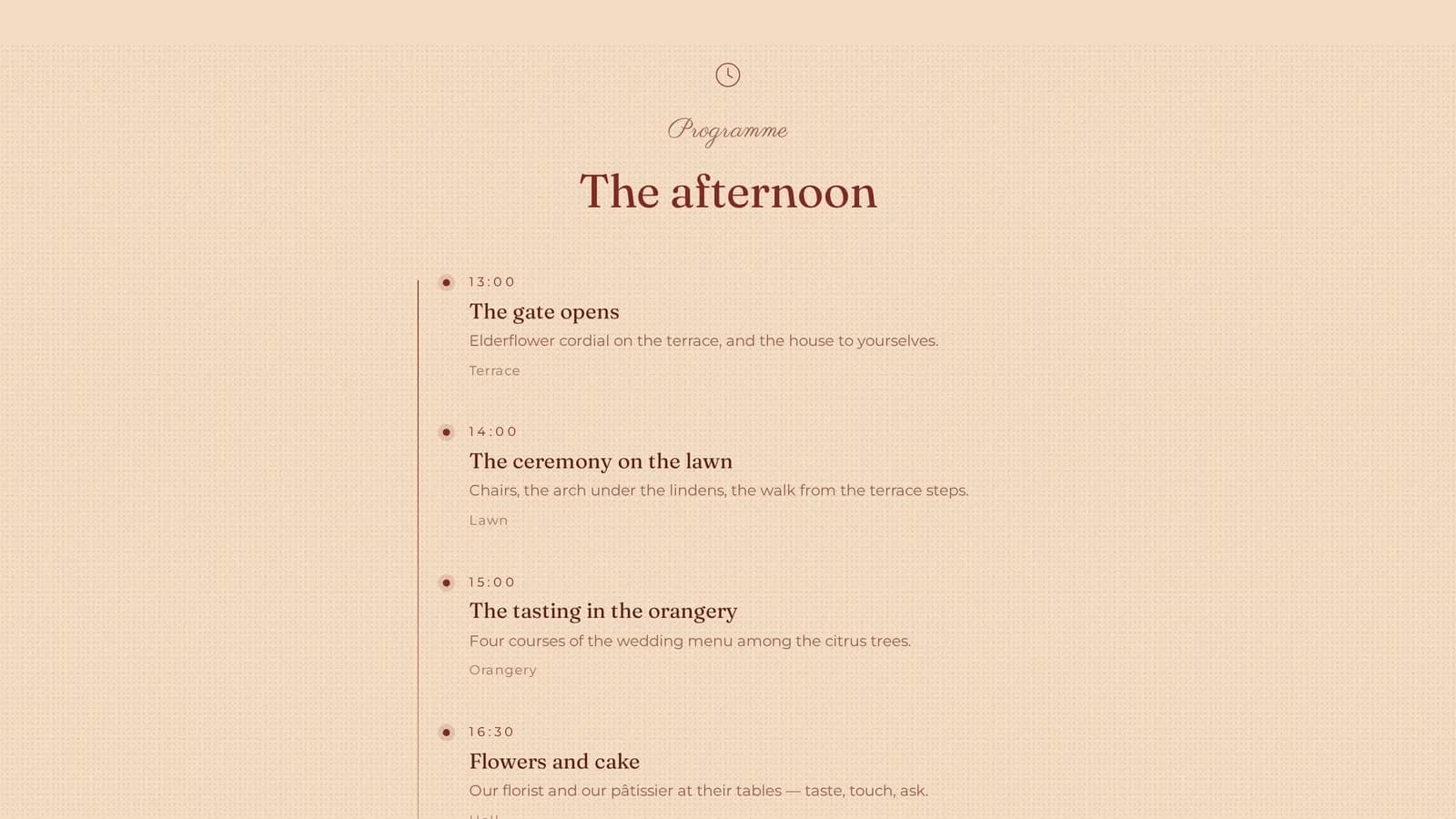
The programme typed once becomes, on the day of the fair, a Now-and-Next bar at the top of the page — the only feature switched on from the start.
You enter the programme once, with times: the dress show, the first-dance demonstration, the cake tasting, the cocktail demonstration, the prize draw. On the day, a bar appears at the top of the page with what is on now and what is next. Order comes from the programme rather than the clock, so an after-party at 00:30 does not read as “now” all morning.
If the band is late and the show moves by forty minutes, you change one time in the programme and the bar moves with it; the printed running order does not. A visitor who can read the answer on their phone is a visitor who is not standing at your desk asking what time the catwalk starts.
What should a fair’s page give visitors?
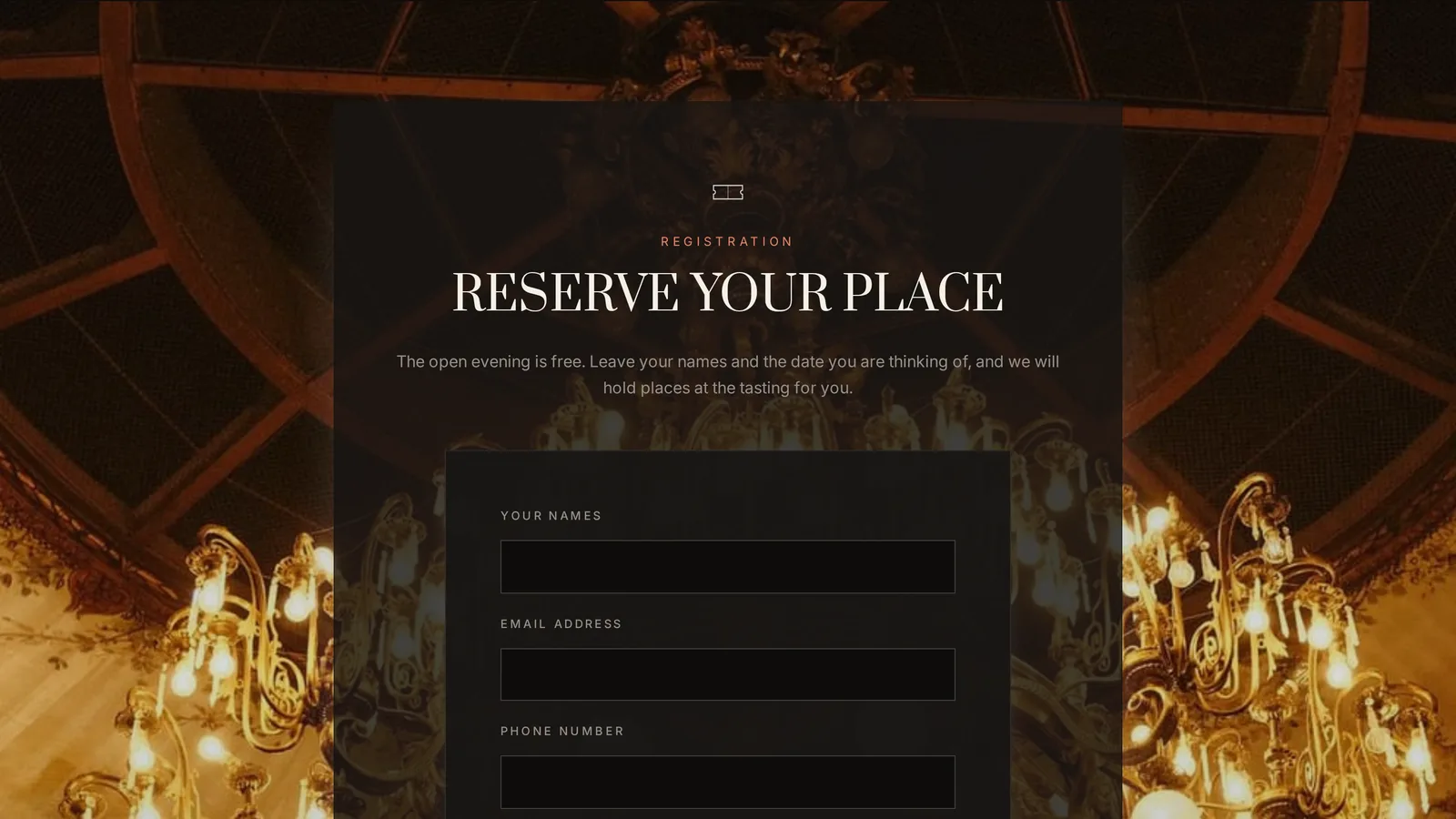
A visitor wants four things: the date and opening times, the programme, the floor plan with the exhibitor list, and a sign-up form. Everything else can wait.
Fair websites split their navigation two ways — for couples, and for exhibitors — because the two readers want opposite documents. A couple wants times, the programme, the plan of the room and a ticket; an exhibitor wants the terms, the stand prices and the application deadline. Both paths belong on one page, one under the other, so a shared link works for whoever opens it.
You can also let couples keep what they liked. Switch saving on and every exhibitor card gets a heart; the ones they tap collect in a drawer on their own phone, with no account and no login. The sign-up form asks for names and an email address, and for the wedding date by default; phone number and expected guest count are questions you turn on yourself.
What do you give exhibitors so they rebook?
Three numbers for every exhibitor: profile views, stand scans and how many couples saved them — and those three numbers are how next year’s stand is sold.
- Profile views
- How many times visitors opened that exhibitor’s card.
- Stand scans
- How many phones scanned the QR code at their stand.
- Saved by couples
- How many couples kept them on a phone shortlist.
- Category on every row
- Shows whether the draw was photography or the cake.
- One row per exhibitor
- The whole line-up on one screen, counted for you.
- You send it yourself
- Nothing is emailed automatically; you retype the numbers.
- No file export
- The figures are read on screen; CSV export does not exist.
- Next year’s price talk
- Three numbers instead of “it felt busy, thanks”.
The screen holding these numbers is open to the account owner and admins only — a team member who edits the page cannot see it.
How much should you charge exhibitors for a stand?
A venue-run wedding fair charges roughly £100 to £300 plus VAT per stand, and the number is set by the couples you can prove, not by the floor space.
£100 + VAT
Per date at The Guildhall Wedding Fair in Salisbury, 2026 — the fee buys a 6ft table, two chairs and a cloth.
£120–£295 + VAT
A 6ft × 4ft pitch for the whole weekend at The Big Southwest Wedding Fair, 2026; upstairs costs less than downstairs.
10%
The discount The Guildhall gives an exhibitor booking both its 2026 dates — rebooking priced in, rather than hoped for.
Exhibitor packs published by the organisers and read on 31 August 2026: The Guildhall Wedding Fair 2026 exhibitor application form (Salisbury City Council) and The Big Southwest Wedding Fair 2026 exhibitor page.
Exhibitor packs published by the organisers and read on 31 August 2026: The Guildhall Wedding Fair 2026 exhibitor application form (Salisbury City Council) and The Big Southwest Wedding Fair 2026 exhibitor page.
What goes wrong at a venue’s first wedding fair?
The usual failures are a date that clashes with a bigger show, three photographers in one room, an exhibitor list only as a PDF, and no visitor sign-up.
A date somebody else owns
Engagement season runs from Christmas to Valentine’s Day, and every regional fair is chasing the same Sundays. Check the directories and the local listings before the invitations are printed, or take the weekend straight after the big show, when couples know what they are looking for and have run out of stands to visit.
Three cake makers, one room
Categories without exclusivity break both sides at once: exhibitors share one queue and do not come back, and the couple leaves without remembering a single name. Twenty stands in twenty categories beats thirty stands in twelve.
The exhibitor list as a PDF
A PDF is not a page. It opens badly on a phone, nothing in it is tappable, and nobody returns to it after the day. The exhibitor list should be a section of the page, with a card, a category and links for every business.
No visitor registration
Without a form you have footfall, not a list. “About two hundred people came” cannot be turned in February into a phone call to one couple with an August wedding date — and that list is the only reason a venue hosts a fair instead of buying a stand at somebody else’s.
Silence after the fair
An exhibitor who receives no numbers will price your stand from memory, and what they remember is the last hour, when the room emptied. A report sent on Monday costs less than the discount they will ask for next year.
Too many stands for the room
Measure with the aisles, not the floor: two metres between rows, clear exits, and somewhere a couple can stand and talk. A cramped room looks full for an hour and then empties, and the stands at the back are the ones that notice.
Questions organisers ask
What is the difference between a wedding fair, a showcase, an open day and a show?
A wedding fair sells stand space to suppliers at a venue. An open day is the venue on its own, with few suppliers or none. A showcase has suppliers dress the rooms as if for a real wedding. A wedding show is the arena version with sixty or more exhibitors, following fizzydo.co.uk’s taxonomy of the four.
Is it a wedding fair or a wedding fayre?
Both spellings are in daily use by UK organisers, and the trade argues about it in public: diverse-events.com published “It’s ‘FAIR’ not ‘FAYRE’”, while Collins calls fayre a pseudo-archaic spelling of fare. Pick one for your event name, mention the other once on the same page as a synonym, and never create a second website for the alternative spelling.
How much should I charge exhibitors for a stand?
Venue-run fairs in the UK charge roughly £100 to £300 plus VAT per stand. The Guildhall Wedding Fair in Salisbury charges £100 plus VAT per date for a 6ft table, two chairs and a cloth; The Big Southwest Wedding Fair sells a 6ft × 4ft pitch from £120 plus VAT upstairs and from £295 downstairs, for the whole weekend.
Should a wedding fair be free to enter?
Free entry with a pre-booked ticket is the common UK pattern, sometimes with a small fee on the door. Free entry costs you the gate money and buys the two things worth more: a fuller room for your exhibitors to sell to, and a registration form that captures names, email addresses and wedding dates before anybody arrives.
How many suppliers should a wedding fair have?
A venue fair is far smaller than a wedding show, which fizzydo.co.uk describes as having in excess of 60 suppliers. Size it by the room and the aisles rather than by ambition, and sell by category rather than by number: one exhibitor per category, with the corners given to the categories whose queue needs somewhere to go.
How do I prove ROI to my exhibitors?
Give each exhibitor their own three numbers after the day: profile views, stand scans and how many couples saved them. They are counted per exhibitor and shown with the category, so a photographer can compare their stand against the rest of the room rather than against a feeling. Nothing is emailed automatically — you send the numbers yourself.
How do couples navigate a big wedding fair?
With a plan they can tap. Upload the drawing of the room, place the stands on it, and a couple taps a stand on their phone to open that exhibitor’s card. Add a QR passport if the far end of the room needs traffic, and a live Now / Next bar so that nobody misses the dress show they came for.
How do I check no other wedding fair is on the same day?
Search the wedding fair directories for your county before you commit. Guides for Brides, Bridebook and the regional Eventbrite collections all list fairs by date, and every organiser near you is listing there. Checking that calendar is the first step in Eventbrite’s own guide, and it is the cheapest mistake on this page to avoid.
Do I need an app for a wedding fair?
No. A wedding fair needs a page a phone camera can reach, not an install: the floor plan, the exhibitor list, the programme and the sign-up form on one address, with printed QR codes at the stands. Asking a couple to install anything at the door costs more visitors than any feature inside that app could return.
Build your wedding fair page
The floor plan, the exhibitor line-up, the programme and registration on one page, with a printable QR sheet before load-in.
The button opens a passwordless sign-in by email. The venue account takes under a minute.