Guide for venue teams
Wedding venue marketing — how to get more enquiries and fill your dates
This guide is for whoever answers the phone and the enquiry inbox at a wedding venue: the channels couples actually arrive through, what each one costs, how long it takes to produce a first enquiry, and the numbers worth keeping.
Updated:
Where do wedding venue enquiries actually come from?
From five places, and never from one venue at a time: the map listing, directories, your own website, social media and your own events. The same couple writes to several venues in one evening, so every enquiry is contested.
We are not going to print one national marriage count here as if it held everywhere. Those series are published country by country, on different timetables and different definitions, and a figure from one market tells a venue in another nothing it can act on. Where a number on this page comes from one country, it is named with that country and its year, and it is there as an order of magnitude rather than as your price. What is the same in every market is the shape of the contest: a couple shortlists in one evening and sends the same question to everyone on the list.
So the work has moved. Winning is less about being seen than about an enquiry landing on one list and being answered the same day. Some of it is lost earlier: Bridebook reports that 59% of couples will not even contact a wedding venue if pricing is not available online. They do not send a shorter enquiry — they send it elsewhere.
Which wedding venue marketing channels are worth the money?
A Google Business Profile and a directory listing produce enquiries within days, SEO takes months, and an open day is the only channel measurable from click to contract.
| Channel | Cost | Time to first enquiry | What it is genuinely good at |
|---|---|---|---|
| Google Business Profile | Free | days | Couples searching “wedding venue near me” reach your map pin, phone number and reviews — the strongest free channel a venue has |
| Directory listing (Bridebook, Guides for Brides, The Knot) | US tiers $50–$1,200+ a month; $6,000–$12,000 a year in competitive metros; $50–$200 per lead (fullybookedvenue.com) | days | Volume you cannot build yourself. Honestly: intent is shallow, and the same enquiry goes to ten venues at once |
| SEO on your own website | An agency retainer, quoted monthly; no published benchmark we could verify in any market | months | The slowest channel here, and the only one still working a year later without more budget |
| Facebook event and paid ads | Free organically, plus whatever you spend on ads | hours | Reach, sharing, and the fastest first reply there is — a couple messages you and you answer in the same minute |
| Free | weeks | Shows the room dressed for a wedding better than any description, but captures no wedding date on its own | |
| Agency landing page | Quoted per project and rarely published; expect four figures in any market | 3 days – 8 weeks | A page written to convert by someone who does it for a living |
| Open days and wedding fairs | Catering and styling are yours; a stand at someone else's fair is priced per square metre | weeks | The highest intent of any channel, and the only one showing the path from page view to date enquiry |
| Supplier and couple referrals | Free | unpredictable | The highest conversion rate on this list, and no control over how many arrive this month |
How do you rank a wedding venue's Google Business Profile?
A Google Business Profile is a wedding venue's strongest free channel: set the right category, name the years still free, add photographs monthly, reply to every review.
Primary category: wedding venue
Category is the strongest single field on the profile. Set “Wedding venue” as primary and keep hotel or restaurant as secondary. A venue filed under “restaurant” drops out of the results for “wedding venue in” plus its own town, even when it has exactly what the couple wants.
Put the year in the description
Couples do not search for “availability” — they search with a year attached. Write “dates still available for 2027” into the description, the posts and the service names, and change the digit when the season rolls. A minute's work, matching the words people type.
Photographs every month, not once
A profile holding five photographs from 2019 reads as closed. Add a few monthly: the room dressed for a wedding, laid tables, the entrance, the car park, the garden. Photographs of a real wedding only with the couple's written permission.
Hours somebody actually answers
Opening hours read as a promise that a person will pick up. If the office is shut on Mondays, say so. If someone answers until 8pm on Saturdays, say that too — Saturday is when couples drive around looking at venues.
Services and a price from
Fill the services list with the words couples use: wedding breakfast, drinks reception, ceremony, dry hire, tasting, accommodation. A guide price filters out enquiries that were never going to book, and shortens the conversation with the ones that were.
Write your own questions and answers
Anyone can post a question on your profile, so post yours first. Use what you hear at every show round: corkage, minimum spend, parking, accommodation, children's menus, how late the music runs. Never answer with “please get in touch”.
Post the open day with a link
For three weeks before an open day, publish one post a week linking to the event page. The people seeing your profile are searching for a venue in your area right now — the warmest audience you have, and the only one you are not renting.
Same name, address and phone everywhere
Name, address and telephone number should read identically on the profile, on your site and in every directory. Check the map pin: a rural venue is often pinned to the main road rather than the entrance, and couples end up in a neighbour's drive.
How do you get more reviews for a wedding venue?
Wedding venue reviews are asked for once, by name, a week after the wedding, in a short message linking straight to the review form.
Timing matters more than wording. On the day nobody is holding a phone, and a month later the feeling has faded. The week after the wedding, when the first photographs arrive from the photographer, is when people write the longest reviews. The person who ran that wedding should ask, in their own name.
Reply to every review, the bad one included, and keep replies short. You are writing to the next couple reading on a phone on a Thursday evening, not to the author. Two factual sentences under a complaint about parking do more than ten compliments. Google prohibits buying reviews or rewarding them with a discount.
Ask for something specific, because a review is text somebody will read in the results: “say how many guests you had and what finally decided it”. Back comes “130 guests, the barn, parking for everyone” — the words the next couple is typing. Directory reviews count, but the Google map is the first screen.
What is missing from most wedding venue websites?
Most wedding venue websites are missing three things: a guide price, the dates still free for the next two seasons, and a form that asks for the wedding date.
A couple opens your site on a phone, usually in the evening, looking for four things: how many it seats, what it costs per head, which dates are free and how to get there. If one is missing they send the same question to the next venue. Put the phone number where it shows without scrolling, and publish a range even if you will not publish a price.
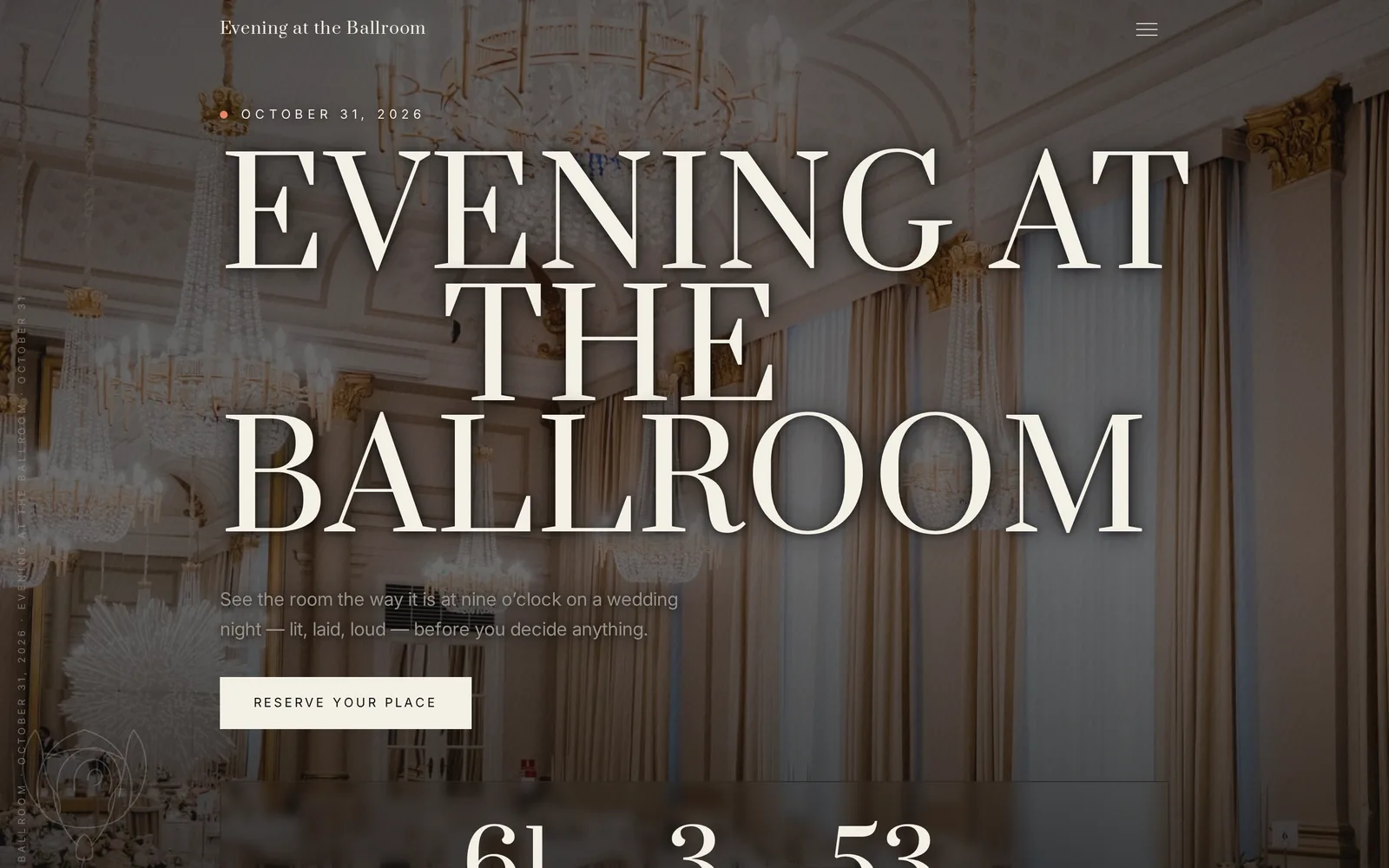
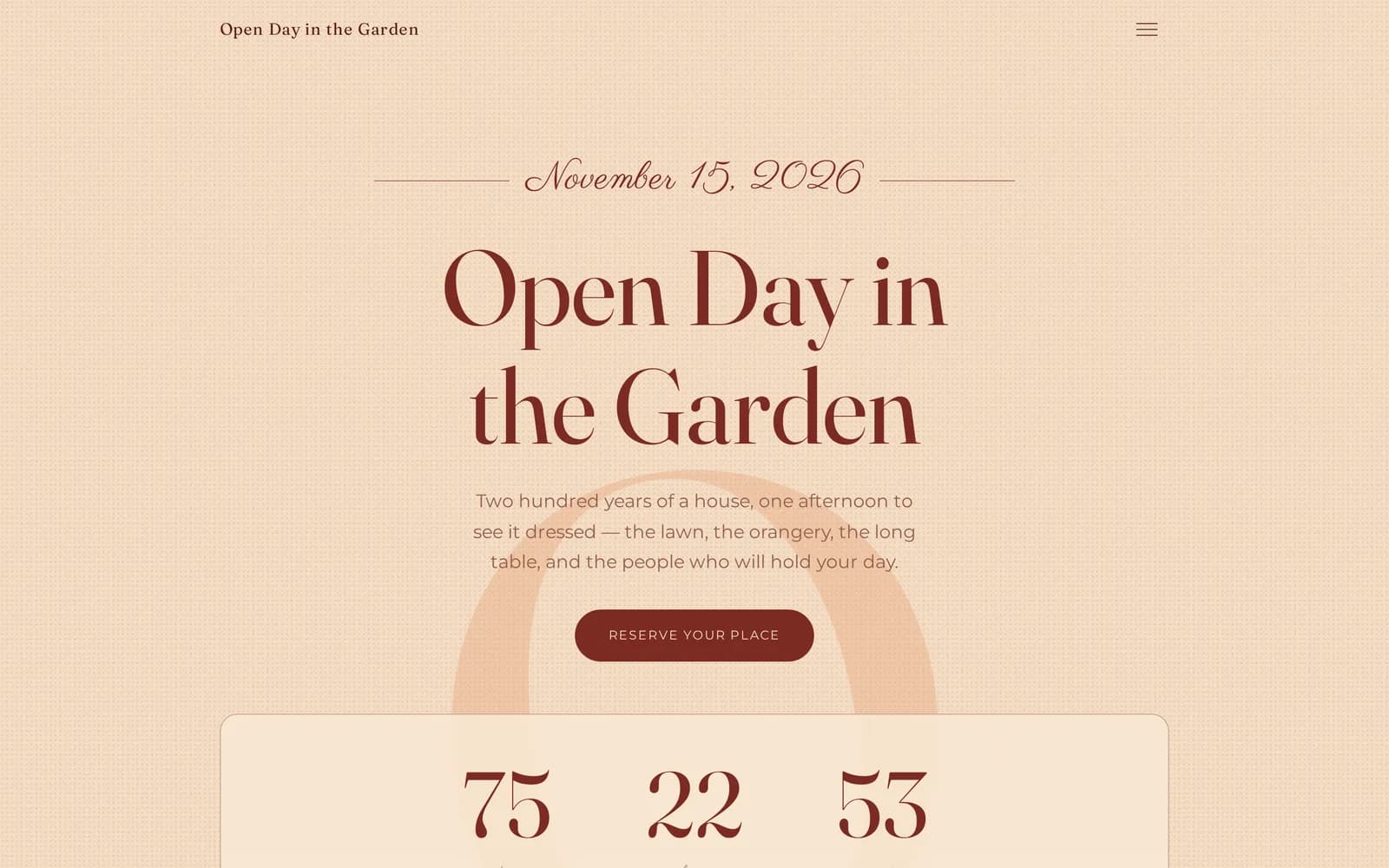
Keep the enquiry form to three fields plus the wedding date — three is the optimum a conversion study by zaprojektowani.com puts forward, and every extra field is one more person who changed their mind. A single event earns its own address, and that is the page you build with us. Open a finished one on your phone: the three showcase venues are fictional, every section is on, and the forms work and store nothing.
How should a wedding venue use Facebook and Instagram?
Facebook invites and Instagram shows the room, but contact details have to be collected elsewhere — an “Interested” list is profiles, not email addresses and wedding dates.
The division of labour is worth holding to. Facebook is where the event lives: the invitation to the open day, shares between friends, questions in the comments, instant replies in Messenger. Instagram is where the venue lives: real weddings posted with permission, the room dressed for a wedding, stories from the day, the chef at a tasting.
The honest part is that the reach is rented. An event is archived once the date passes, the “Interested” list is profiles without email addresses, and the algorithm owes you nothing. So a Facebook event's job is to carry one button through to a page that collects. Leave Messenger doing what it is best at, then ask for an email and a date.
Rhythm beats polish: two or three posts a week through enquiry season, stories on the day itself, and a bio naming the year couples type — “dates available for 2027”. The link in the bio should point at the next event, not the homepage. Once a quarter, count how many enquiries really came from here.
Why is an open day the only wedding venue channel you can measure?
An open day is the only channel where a venue sees the whole path a couple takes: the page view, the QR scan, the sign-up and the date enquiry.
Every other channel sells you a proxy. Ads report impressions, Instagram reports likes, a directory reports profile clicks. An open day produces a list of engaged couples with an email, a phone number and a wedding date, plus the numbers from the day: page views, scans at a stand, sign-ups, date enquiries. That is what lets you say February beat November, and know why.
Running the day is a separate job, written up separately: the open day as a sales channel — full guide, with the hour-by-hour open day run sheet. If you are choosing between your own event and a stand at someone else's, there is a comparison too: wedding fairs — your own, or someone else's stand. In the studio it lands on one screen, the eight numbers an event is measured by.
How do you fill the dates you still have open?
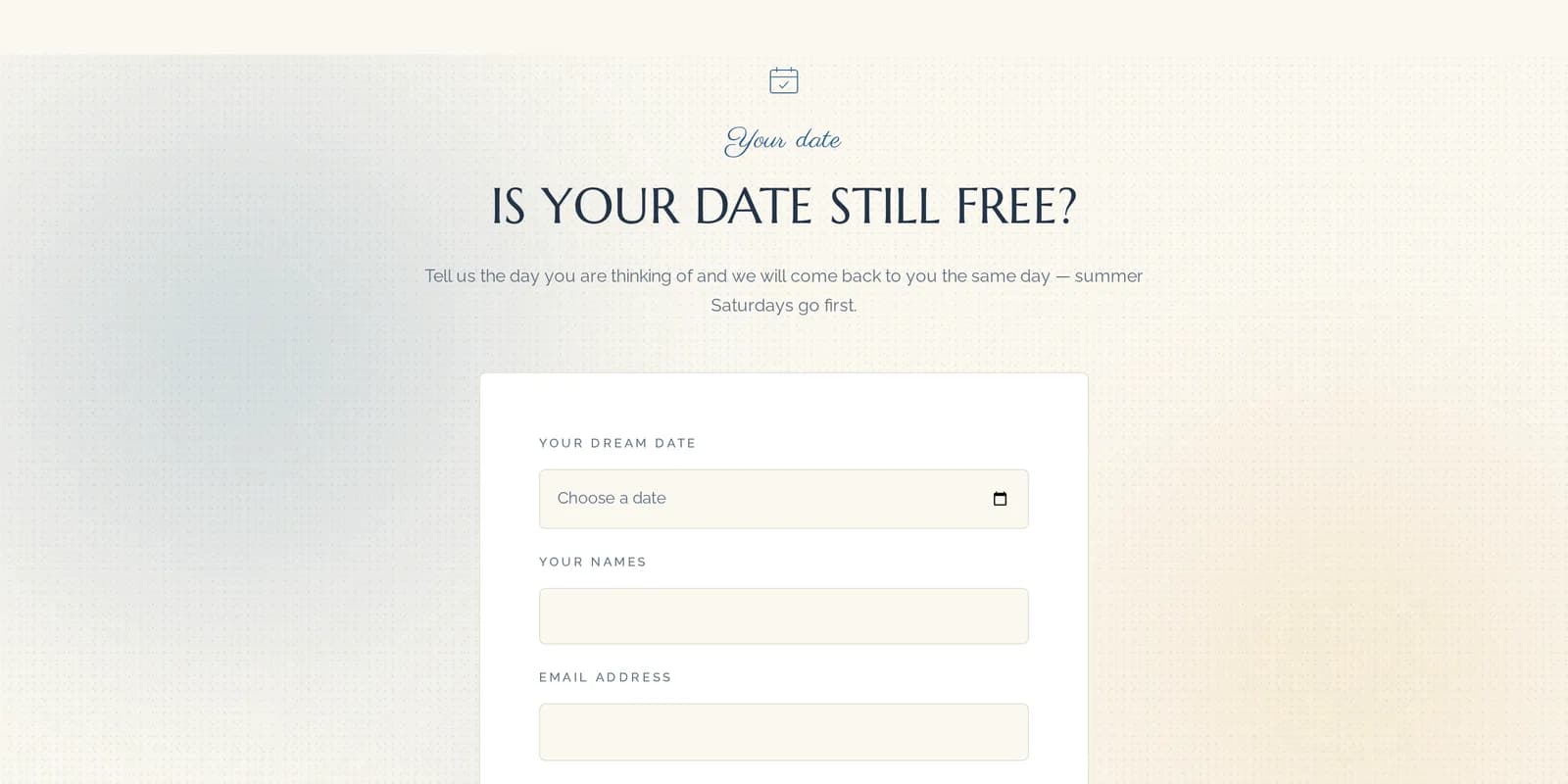
Couples search for a wedding venue with a year attached, so name the year on the page and collect the enquiry as a date they pick.
The pattern is easiest to see in the results themselves: directories title their pages with the year — “wedding venues, dates available 2026/27” — and individual venues rank on “last remaining 2027 dates”. We have no ranking study to cite for it, so treat it as an observed pattern rather than a rule. A couple with a date in mind types the date.
Put the year in four places: the page heading, the Google Business Profile description, your directory listing and the page for your next event. Then collect the answer as a date rather than prose. On an event page you switch on the “Is your wedding date free?” section, and it arrives with the date in its own column — where date enquiries land, and where they can be sorted.
How fast do you have to reply to a wedding enquiry?
Within five minutes. Companies replying inside five minutes are a hundred times more likely to reach the person than those replying after half an hour.
100×
more likely to get into a conversation with the couple when the reply goes out within five minutes rather than after half an hour
78%
of customers say they bought from the company that responded to their enquiry first
14% → 25%
conversion moved this far in two months when average response time fell from three hours to seven minutes
Harvard Business Review and InsideSales lead-response research (accessed August 2026). Cross-industry rather than wedding-trade figures — read them as a direction, not a promise.
Harvard Business Review and InsideSales lead-response research (accessed August 2026). Cross-industry rather than wedding-trade figures — read them as a direction, not a promise.
What should happen to an enquiry so it does not get lost?
A wedding enquiry survives only when it lands on one list carrying the wedding date, a phone number and its source — not in three places at once.
One list, not three
Plenty of venues still take open day sign-ups as an email thread with the wedding date in the subject line, or by phone with a note in the diary. Both work right up to the moment somebody has to produce the list, and then there is nowhere to print it from.
The wedding date as a field, not a sentence
“We are thinking about next September” cannot be sorted. A date in its own column is a list you work through in date order in January. In the studio that view is where date enquiries land, with a date beside every couple.
Consent, separate and stored
The venue is the controller of data collected at its own event, so you answer “where did you get my address?”. Consent to be contacted should be its own explicit field on the form, stored with the entry — not a pre-ticked box or a line in terms and conditions.
Who answers on a Saturday
Enquiries arrive in the evenings and at weekends, because that is when couples talk about the wedding. Response time is a rota question rather than a software question: decide who has the phone on Saturday and until when, then put that hour on your profile.
Nothing will notify you
WeddieEvents does not email you when an enquiry arrives — you open the leads screen yourself, and only the account owner and admins can see it. Build it into the day: morning and afternoon, the way you check bookings. A habit beats waiting for an alert.
Follow-up has a rhythm
First reply in minutes, second within two days, third after a week, then stop, because silence is an answer too. We set that cadence out with the wording in the open day guide. Here it is enough that every enquiry has an owner and a next date.
How do you fill midweek and off-peak wedding dates?
Off-peak and midweek dates sell on a different product rather than louder advertising, and they sell in January, when Hackney Council in London reports a 200% increase in venue-page visits.
Start with the calendar. Engagement season runs from late November to Valentine's Day, and Hackney Council in London reports an average 200 per cent increase in visits to venue pages and a 50 per cent spike in calls and emails after Christmas and Valentine's. The weddings themselves cluster the other way, into the warm months, which is why the good dates are argued over in winter.
That gives the venue's year a shape. September and October: publish the dates you still have and tidy the Google profile. November to February: the open day, the fairs, the wave of enquiries. March to May: tastings, show rounds, contracts. June to September: you are running weddings and collecting the photographs and reviews you will spend in winter.
The date itself sells on the offer, not the ad spend. A Friday or a Sunday, sixty guests instead of a hundred and fifty, dry hire in the quiet months, winter styling, accommodation included. Name the difference in the price rather than hiding it. And an open day in November attracts couples planning a November wedding, because those are the ones looking then.
What should a wedding venue measure?
Three things: where the enquiry came from, how many minutes the reply took, and whether the couple came for a show round. The rest is reach, which books nothing.
- Source
- profile, directory, Facebook, referral, open day, own site
- Date and time received
- without it you cannot calculate response time
- Time to first reply
- counted in minutes, not in days
- Wedding date
- the field you sort by and plan the season around
- Guest numbers
- turns an enquiry into a revenue figure per head
- Status
- new, replied, show round, proposal, booked, lost
- Reason lost
- price, date taken, couple stopped replying
- Show round or open day
- whether the couple came to the venue, and when
- Reply channel
- phone, email, Messenger — which one closes faster
- Month booked
- shows how long your sales cycle really runs
Ten columns in one spreadsheet is enough — at the end of the season they answer which channel brought contracts rather than clicks.
What marketing mistakes do wedding venues make most often?
The commonest wedding venue mistakes are hidden pricing, no dates published, a reply two days later, empty photographs of the room at noon, and reporting reach instead of enquiries.
Pricing “on enquiry”
Hiding the price buys more enquiries and fewer bookings, because half fall away at the first number anyway. Some venues do it deliberately, wanting the conversation — fair enough. But if nobody has time to ring back, a per-head “from” figure saves you twenty calls a month.
The empty room at noon
The commonest photograph of a wedding venue online is an empty room in daylight with the chairs stacked against the wall. It shows square metres, not a wedding. What converts is the room dressed: laid tables, flowers, people, the evening light the couple will see.
Monday's reply to Saturday's enquiry
Enquiries arrive at the weekend because that is when couples talk about the wedding. A Monday reply reaches a couple who wrote to five venues on Saturday night and booked a viewing on Sunday with whoever answered first. The cheapest leak in the funnel to fix.
A whole channel you do not own
The event on Facebook, sign-ups in the comments, photographs in a story — and nothing left when the season ends. The reach is rented, the “Interested” list is profiles, and nobody visits an archived event. Facebook is an excellent invitation and a poor filing cabinet.
One open day a year and no numbers
If a whole year of lead generation happens in one afternoon, that afternoon is where measurement matters most. “It was busy” will not defend next year's budget and will not tell you whether November or February was better. Sign-ups and date enquiries will.
The same post for everybody
A couple looking at July 2027 and a couple looking at a Friday in November are two different offers. One message saying “we still have dates available” speaks to neither. Split it at least into peak and off-peak — the simplest segmentation there is.
Marketing with no name on it
An info@ address and a sign-off from “the venue team” is the weakest possible ending to a wedding proposal. A couple chooses a venue but talks to a person, and it is that person's name they remember. Sign replies with a name and a direct number.
Wedding venue marketing — common questions
How do I get more wedding enquiries?
More wedding enquiries come from four things done together: a complete Google Business Profile naming the years you still have free, a listing on one or two directories, a website that publishes a guide price and asks for the wedding date, and one event a year that you leave holding a list of engaged couples.
Should I put my prices on my website?
Publish at least a range. Bridebook reports that 59% of couples will not even contact a wedding venue if pricing is not available online, so a hidden price does not delay the question — it removes you from the shortlist. A per-head “from” figure filters out enquiries that were never going to book.
How fast should I reply to a wedding enquiry?
Within five minutes where you can. Harvard Business Review and InsideSales lead-response research records a hundredfold better chance of reaching someone when the reply goes out inside five minutes rather than after half an hour, and 78% of customers say they bought from whoever answered first.
What conversion rate should a wedding venue expect?
EverBridal publishes 30–40% of show rounds converting into bookings, and 60% or more at the strongest venues. Those are their figures rather than research, so use them as a benchmark to argue with. Measure your own two ratios — enquiry to show round, show round to booking — for one season instead.
How many follow-ups before I give up on a lead?
Three or four, spaced deliberately. The ranking answer in this niche (thelindsaylucas.com) suggests a thank-you the same day, a second email at two days and a third at four, and notes most sales close after ten or more touch points. Then stop: a clean “lost” status beats a lead you half-chase.
When is engagement season and how do I prepare?
Engagement season runs from late November to Valentine's Day and the traffic follows it: Hackney Council in London reports an average 200 per cent increase in visits to venue pages and a 50 per cent spike in calls and emails after Christmas. Prepare in September and October, and book the open day into January or February.
How do I fill midweek and off-peak dates?
Sell a different product rather than the same one more loudly. Fridays and Sundays, smaller guest numbers, dry hire in the quiet months, winter styling, accommodation included — and a price that names the difference instead of hiding it. Hold the open day off-peak too: a November event attracts November couples.
What metrics should a wedding venue track?
Three per enquiry: the source, the time to first reply, and whether the couple came for a show round. At the end of the season those three columns tell you which channel produced contracts rather than clicks. Reach, likes and follower counts do not answer that question.
How much does it cost to advertise a wedding venue?
The only tiers we can quote are American: fullybookedvenue.com puts directory advertising between $50 and $1,200+ a month, $6,000–$12,000 a year in competitive metros, at a cost per lead of $50–$200. Outside the United States most directory and agency pricing is quoted on request rather than published, which is worth knowing before you ask.
How do I measure which marketing channel brings the bookings?
Add one mandatory field to every enquiry — where it came from — and never let anything be saved without it. Ask on the phone as well; “how did you find us?” takes four seconds. After one season, group your signed contracts by that field. It will disagree with your impressions.
Start measuring your enquiries
Build your next open day page and see how many date enquiries it brings.
You click, you give an email, a link arrives, and you're in the studio. No password, no card, no sales call.